Abbakaon

Opinion. Commonsense. Real news
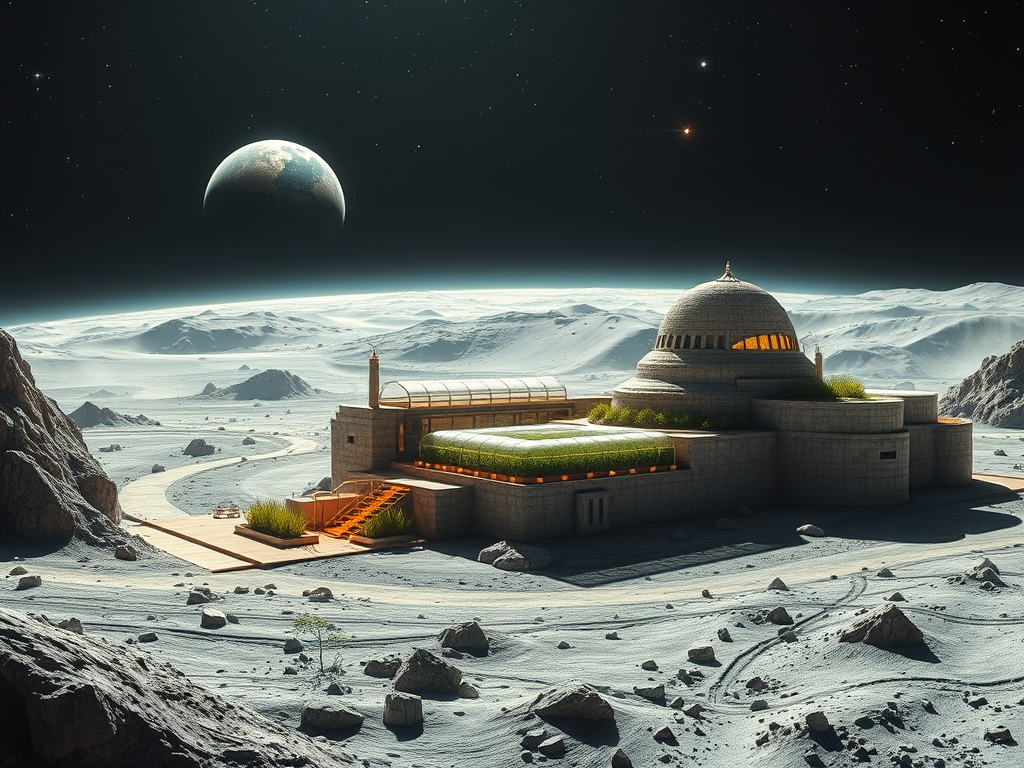
The civil engineering of spatial sustainability: autarky

In the realm of aerospace exploration, we often focus on the “how”—the rockets, the propulsion, and the daring landings. However, as a civil engineer with experience in public infrastructure, my focus is on the “what happens next.” To build a lasting presence on the Moon or Mars, we must address the most significant logistical bottleneck in human history: the Earthly Umbilical Cord.

For a settlement to transition from a precarious scientific outpost to a thriving human community, it must achieve sustainability: Autarky. In engineering terms, this means reducing dependence on Earth-side supply chains to a statistical minimum.

The Mass-Energy Paradox

Currently, the cost of transporting a single kilogram of material to the Lunar surface remains a barrier to entry for large-scale operations. From a “common sense” advisory perspective, shipping basic construction materials like steel or concrete from Earth is not just inefficient; it is a strategic failure. We cannot build following God’s design—which favors harmony and local adaptation—if we are forcing terrestrial materials into extraterrestrial environments at an unsustainable cost.

In-Situ Resource Utilization (ISRU): The New Quarry

The first pillar of space autarky is ISRU. On Earth, we source gravel, sand, and water locally to build our cities. On the Moon, the lunar regolith must become our primary raw material.

  • Sintering and 3D Printing: By using concentrated solar energy or microwaves, we can fuse regolith into “Lunarcrete.” This allows us to print radiation shielding, landing pads, and habitats directly on-site.
  • The Chemistry of Survival: We must move beyond “exploration” and into “refining.” Extracting oxygen from silicates and harvesting water ice from permanently shadowed craters is the only way to sustain life and produce propellant without a constant stream of tankers from Earth.

The Circular Metabolism of Infrastructure

True autarky requires a shift from linear consumption to circular metabolism. In my previous roles managing public works, “waste” was often an afterthought. In a space settlement, waste is a luxury we cannot afford. Every molecule of carbon, nitrogen, and hydrogen must be accounted for and cycled back into the system. This is where civil engineering meets biological systems: creating closed-loop water treatment and atmospheric recycling that mimics the natural cycles found on Earth.

The Green Lung: Biological Autarky and the Role of Vegetation

A truly self-sufficient lunar settlement requires more than just mineral extraction; it requires a living heart. Integrating agriculture and silviculture—the growing of plants and trees—is not a decorative luxury, but a critical engineering necessity. From a biological standpoint, plants act as the settlement’s “Green Lung,” naturally scrubbing carbon dioxide from the air and regenerating breathable oxygen through photosynthesis. Beyond atmospheric regulation, botanical systems provide a sustainable source of fresh nutrition, reducing the psychological and physical “food miles” from Earth to zero. By utilizing treated greywater and regolith-derived substrates, we can create a regenerative biomass cycle. Following God’s design, I believe the presence of living, growing trees provides an essential psychological anchor for inhabitants, maintaining a vital link to the terrestrial biomes of our home planet and ensuring the mental resilience required for long-term survival in the void.

A Strategic Call to Action for businesses

In my opinion, the winner of the new space race will not be the one with the biggest rocket, but the one who masters autonomous infrastructure.

By investing in self-sufficient technologies today, we reduce the “Payload Penalty” and increase the “Resilience Quotient.” A colony that can repair itself, feed itself, and expand itself using local resources is a colony that will endure.

As we look toward the heavens, we must bring our most grounded engineering principles with us. Autarky is not just a technical goal; it is the fundamental requirement for humanity to truly become a multi-planetary species.

Leave a Reply

Discover more from Abbakaon

Subscribe now to keep reading and get access to the full archive.

Continue reading